
February 20, 2026
PCOS Supplement Protocol
Table of Contents
Key Takeaways
- PCOS is common, and certain supplements can support hormone balance, metabolic health, and fertility.
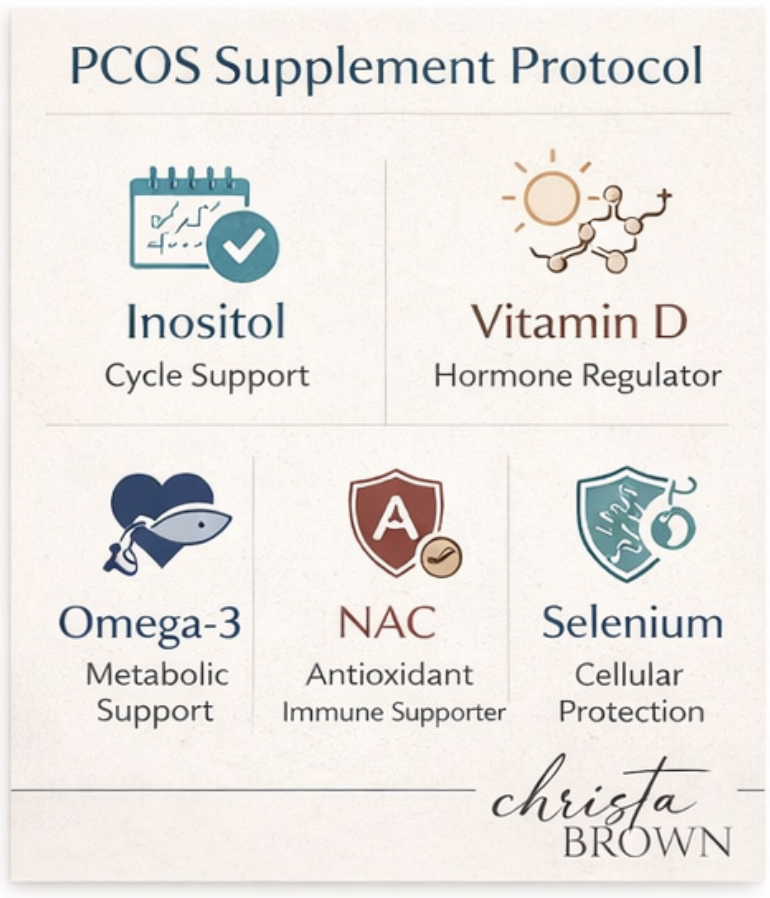
- The five most researched supplements are Inositol, Vitamin D, Omega-3s, N-Acetylcysteine (NAC), and Selenium.
- Supplement needs should be personalized—work with a healthcare professional to choose what fits your symptoms and goals.
- Quality matters: choose reputable brands and allow 2–3 months to see results.
- Supplements are a helpful addition, but not a substitute for healthy habits or medical care.
What the Latest Research Says About Inositol, Vitamin D, Omega-3, NAC, and Selenium
This article provides an overview of a PCOS Supplement Protocol and what current evidence recommends for managing PCOS with these supplements.
PCOS affects about 1 in 10 women of reproductive age.1 Healthy habits and medications remain the main treatments, but new research is offering more options. Some supplements may help support your hormones, metabolism, and reproductive health.
In this guide, I’ll walk you through the latest research on five supplements that may be especially helpful for PCOS: inositol, vitamin D, omega-3s, NAC, and selenium. They are additional considerations in part of a nutrient dense diet for those living with PCOS. I’ll also share some practical tips on how you might work these into your routine, if they feel like a good fit for you.
Inositol: The Insulin Sensitizer
Inositol, especially myo-inositol and D-chiro-inositol, is one of the most studied supplements for PCOS. These natural compounds play important roles in insulin signaling and hormone regulation.
What the Research Shows
- Menstrual Cycle Restoration: A 2024 prospective study demonstrated that 68% of PCOS patients restored menstrual cycle regularity with myo-inositol supplementation, showing clinically considerable improvements in cycle predictability.2
- Ovarian Function: Studies suggest that taking 2 grams of inositol daily can help restore ovarian function, with results as good as or better than clomiphene citrate, a common fertility medication. I sometimes suggest starting with half that amount, or just half a scoop if you use powder.3
- Metabolic Benefits: Research indicates improvements in insulin sensitivity, reduced luteinizing hormone (LH) levels, and better general metabolic parameters.
- Optimal Ratio: The ideal myo-inositol to D-chiro-inositol ratio appears to be 40:1, based on naturally occurring plasma levels in the body.

The Controversy
The 2023 International Evidence-based PCOS Guidelines note that the overall evidence for inositol is still limited, especially for fertility.4 Many studies look promising, but experts agree we need more large, high-quality trials to know how helpful inositol really is for PCOS.
Practical Recommendations
- Dosage: No more than 2 grams of myo-inositol daily, or a combination product with a 40:1 ratio of myo-inositol to D-chiro-inositol
- Timing: Can be split into two doses taken with meals
- Best For: Women with PCOS seeking to improve menstrual regularity and insulin sensitivity
Vitamin D: The Multifunctional Hormone Regulator
Vitamin D deficiency is very common in women with PCOS, and new research suggests this is more than just a coincidence. 5 Vitamin D may actually play an active role in how PCOS develops and how it affects your body.
What the Research Shows
- Metabolic Improvements: Vitamin D supplementation has been shown to regulate insulin resistance, lipid metabolism, and hormone levels in PCOS patients. A small study involving 60 women found that 12 weeks of vitamin D supplementation (2,000 IU per day) was associated with improvements in insulin resistance, body measurements, and cholesterol levels, primarily among those who were obese or insulin-resistant, with little change seen in metabolically healthy participants. 6 Because of the study’s small size, these results indicate a potential benefit but are not conclusive, and larger studies are needed to confirm the findings.
- Fertility Enhancement: A 2023 review found that vitamin D supplementation significantly increased pregnancy rates in PCOS patients, representing a 44% improvement in conception rates. 7
- Hormonal Balance: Supplementation has been associated with decreased total testosterone and DHEA levels, addressing hyperandrogenism—a hallmark feature of PCOS.8
- Causal Relationship: A 2024 Mendelian randomization study suggested that lower serum vitamin D levels may actually cause higher PCOS risk, mediated by increased testosterone production, suggesting the relationship goes beyond simple correlation.9 [A Mendelian study uses the genes you’re born with to help scientists figure out if something actually causes a disease, rather than just being connected to it.]
Dose-Response Insights
More is not always better, so there is an ideal range for best results. It’s important to check your vitamin D levels each year before taking more than the recommended daily amount. I usually suggest a preventative dose of 800-1000 IU during winter to avoid deficiency. Also, take it with a meal with fat in it, so that it absorbs its best!
Practical Recommendations
- Dosage: 1,000-4,000 IU daily for at least 12 weeks
- Testing: Check baseline vitamin D levels and monitor periodically to ensure levels reach 30-50 ng/mL
- Best For: All women with PCOS, especially those with confirmed vitamin D deficiency, insulin resistance, or trying to conceive
Omega-3 Fatty Acids: The Anti-Inflammatory Metabolic Supporter
Omega-3 polyunsaturated fatty acids (PUFAs), especially EPA and DHA from fish oil, have been widely studied for their anti-inflammatory and metabolic effects in PCOS.
What the Research Shows
- Lipid Improvements: Meta-analyses regularly show that omega-3 PUFAs are effective in reducing serum triglycerides and total cholesterol in women with PCOS, addressing a key cardiovascular risk factor. 10
- Insulin Sensitivity: Omega-3 supplementation significantly improves the HOMA index (a measure of insulin resistance) and increases adiponectin levels, a beneficial hormone that improves insulin sensitivity.10
- Body Composition: Higher serum levels of EPA and DHA are negatively associated with HOMA-IR, fat mass, and body fat percentage, suggesting omega-3s may help with metabolic health even independent of weight loss. 12(But note this is in mice studies)
- Fertility Support: A 2023 study found that omega-3 intake improved clinical pregnancy rates in PCOS patients undergoing ovulation induction. 13
- Weight Loss Reality: Omega-3s offer plenty of metabolic benefits, but research shows they don’t have a big impact on weight loss. Try to think of them as a way to support your overall health rather than as a weight-loss supplement.
Practical Recommendations
- Dosage: 1,000-2,000 mg combined EPA/DHA daily
- Form: High-quality fish oil or algae-based omega-3 supplements
- Best For: Women with PCOS experiencing insulin resistance, dyslipidemia, or elevated triglycerides
N-Acetylcysteine (NAC): The Antioxidant Powerhouse
N-acetylcysteine is a strong antioxidant that has gained attention in PCOS research for its effects on oxidative stress, which plays a key role in the condition.
What the Research Shows
- Reproductive Health: A 2025 meta-analysis of 22 studies found that NAC significantly increased progesterone levels and endometrial thickness compared to placebo, both crucial factors for successful conception and pregnancy maintenance. 14
- Fertility Outcomes: NAC demonstrated significant improvements in both pregnancy and ovulation rates compared to placebo. While it was less effective than metformin in some studies, it offers better tolerability for many women.
- Metabolic Benefits: NAC showed a trend of reducing fasting blood glucose compared to both metformin and placebo, and also reduced total cholesterol, demonstrating strong metabolic effects.15 Jury is still out on this one, though.
- Cellular Protection: Research shows NAC treatment boosts antioxidant activity in ovarian tissues, improves mitochondrial function, and reduces oxidative stress in PCOS. This means it may help address root causes, not just symptoms. 16(But note this is in mice studies!)
Practical Recommendations
- Dosage: 1,200-1,800 mg daily, typically divided into 2-3 doses
- Duration: Minimum 6 weeks, with studies showing benefits up to 24 weeks
- Best For: Women with PCOS who cannot tolerate metformin, those trying to conceive, or anyone looking to address oxidative stress
- Special Consideration: NAC being a part of a PCOS Supplement Protocol, although promising, still needs more research to prove its benefit
Selenium: The Trace Mineral for Antioxidant Support
Selenium is an essential trace mineral that plays a critical role in antioxidant defense systems. Research has shown that selenium levels tend to be lower in women with PCOS, making supplementation a potentially valuable intervention. 17
What the Research Shows
- Antioxidant Capacity: Meta-analysis demonstrated that selenium supplementation has a positive effect on total antioxidant capacity (TAC) in PCOS patients, helping to combat oxidative stress. 18
- Metabolic Markers: Selenium supplementation resulted in significant decreases in VLDL cholesterol, malondialdehyde (MDA—a marker of oxidative stress), and high-sensitivity C-reactive protein (hs-CRP—an inflammation marker). 18
- Insulin Sensitivity: Studies show increased QUICKI (Quantitative Insulin Sensitivity Check Index), indicating improved insulin sensitivity. A 2022 randomized controlled trial found that 200 μg/day selenium for 8 weeks significantly decreased fasting glucose, HOMA-IR, fasting insulin, and MDA levels. 20
- Limitations: Selenium does not seem to have much effect on weight, testosterone, or cholesterol in most studies. Its main benefits are reducing oxidative stress and supporting insulin sensitivity.
Practical Recommendations
- • Dosage: 200 μg daily
- • Duration: Minimum 8 weeks for measurable benefits
- • Safety: Do not exceed 400 μg/day due to risk of selenium toxicity
- • Best For: Women with PCOS experiencing elevated inflammatory markers or oxidative stress
Putting It All Together: Your PCOS Supplement Protocol
Each supplement has its own benefits, but many women with PCOS find that a balanced approach works best. Here is a sample supplement routine, based on the latest research, that you can discuss with your healthcare provider to see what fits you best.
| Supplement | Recommended Dosage | Duration | Primary Benefits |
| Inositol | 2g daily (40:1 myo:D-chiro) | Ongoing | Menstrual regularity, ovarian function, insulin sensitivity |
| Vitamin D | 1,000-4,000 IU daily | Minimum 12 weeks, then ongoing | Insulin sensitivity, lipid profile, fertility, hormone balance |
| Omega-3 | 1,000-2,000mg EPA/DHA daily | Ongoing | Triglycerides, insulin resistance, inflammation |
| NAC | 1,200-1,800mg daily (divided) | 6-24 weeks | Oxidative stress, fertility, blood glucose |
| Selenium | 200μg daily | Minimum 8 weeks | Antioxidant support, inflammation |
Important Considerations
Individualize Your Approach
Not everyone with PCOS needs all five supplements. It’s important to work with your healthcare provider to find which ones fit your symptoms and health goals. For example:
- If your primary concern is irregular cycles, inositol should be a priority
- If you have confirmed vitamin D deficiency, correcting this should be foundational
- If you have high triglycerides or cardiovascular risk factors, omega-3s are particularly important
- If you’re trying to conceive and need insulin sensitizing support, NAC might be an alternative option
- If you have markers of high oxidative stress or inflammation, selenium may be beneficial
Quality Matters
Not all supplements are created equal. When choosing a product, look for options that offer the right potency and quality.
- Use the specific forms studied in research (e.g., myo-inositol rather than generic inositol)
- Come from reputable manufacturers with good manufacturing practices (GMP) certification
Track Your Progress

Supplements work best when paired with healthy lifestyle habits and regular check-ins. You might find it helpful to keep track of things like:
- Menstrual cycle regularity and characteristics
- Fasting glucose and insulin levels
- Lipid panel (cholesterol, triglycerides)
- Hormone levels (testosterone, DHEA, LH, FSH)
- Subjective symptoms (energy, mood, hair growth, acne)
Be Patient
Supplements usually take a bit longer to show results than medications, often 8 to 12 weeks of steady use. This is especially true for changes in metabolism and hormones. Try to give your supplement routine at least three months before deciding how well it’s working for you.
The Bottom Line
More research is showing that some supplements can help with PCOS. While they are not a replacement for healthy eating, exercise, and stress management, supplements can support your body and help with specific hormone or metabolic issues.
Inositol, vitamin D, omega-3s, NAC, and selenium each have their own unique benefits, and there’s some research to back them up. The most important thing is to find the supplements that match your needs and to work with a healthcare provider who can help you create a plan that feels right for you.
PCOS is different for everyone, so what works for one person might not be right for you. Use this information to start conversations with your healthcare team, and trust yourself to make changes as you learn what works best for your body.
If you’re looking for PCOS support, please feel free to learn more of how I can support you here!
Disclaimer: This article is not intended to provide medical advice, diagnosis, opinion, treatment or services. This article and the links contained in it provide general information for educational purposes only. The information provided in this article is not a substitute for medical care, and should not be used in place of the advice of your physician or registered dietitian.
We are a health and wellness site, with work written by Registered Dietitians or Medical Professionals, please review our editorial process here.
Frequently Asked Questions
A PCOS supplement protocol is a structured, research-backed way to use targeted supplements like inositol, vitamin D, omega-3s, NAC, and selenium to support hormone balance, insulin sensitivity, and reproductive health in women with PCOS. Not every woman with PCOS needs all five supplements. Working with a PCOS-specialized registered dietitian, like Christa Brown in Woodbridge, NJ, can help you find which supplements fit your symptoms, lab work, and health goals.
While the supplements in this PCOS protocol are generally well-tolerated, it is always best to work with a healthcare provider before starting. Dosing, timing, and interactions with medications like metformin or birth control all matter. If you are in the Woodbridge, NJ area or anywhere in New Jersey, working one-on-one with a registered dietitian ensures your protocol is personalized and not just copied from a general list online.
The five most research-supported supplements for a PCOS supplement protocol are inositol (2–4g daily at a 40:1 myo:D-chiro ratio), vitamin D (3,000–4,000 IU daily), omega-3 fatty acids (1,000–2,000mg EPA/DHA), NAC (1,200–1,800mg daily), and selenium (200mcg daily). Each targets a different aspect of PCOS, from insulin resistance and inflammation to oxidative stress and fertility support.
ome nutrients overlap with food sources — omega-3s from fatty fish, selenium from Brazil nuts, and vitamin D from sunlight and fortified foods. However, reaching the therapeutic doses used in research through diet alone is difficult, especially for inositol and NAC. A PCOS-focused dietitian can help you understand where food fills the gaps and where a targeted supplement protocol becomes necessary.
Research shows several supplements in a PCOS protocol can support fertility. Vitamin D supplementation was linked to a 44% improvement in pregnancy rates in a 2023 meta-analysis. Inositol has shown results similar to clomiphene citrate for ovarian function. NAC significantly improved progesterone levels, endometrial thickness, and ovulation rates in a 2025 meta-analysis. If you are trying to conceive, working with a specialist in the Woodbridge, NJ area can help you build a fertility-focused PCOS supplement protocol with your reproductive care team.
A multivitamin gives general nutrition at low doses. A targeted PCOS supplement protocol uses specific forms of nutrients at the higher doses studied in research. For example, it might include 200mcg of selenium instead of the 55mcg in most multivitamins, or 3,000–4,000 IU of vitamin D instead of the 400–800 IU in a standard multi. The difference in dose and form is what leads to the results seen in PCOS research.
Christa Brown is a Registered Dietitian based near Woodbridge, NJ, specializing in PCOS, hormone health, insulin resistance, and fertility nutrition. She works with clients one-on-one, both in person and virtually across New Jersey, to build personalized PCOS supplement protocols based on your labs, symptoms, and health goals. Insurance is accepted. Learn more and book a consultation at christabrowndietitian.com/apply
- World Health Organization. Polycystic ovary syndrome (PCOS). ↩︎
- Sharon PM, Manivannan A, Thangaraj P, BML. The effectiveness of myo-inositol in women with polycystic ovary syndrome: a prospective clinical study. Cureus. 2024;16(2):e53951. doi:10.7759/cureus.53951 ↩︎
- ordio M, Basciani S, Camajani E. The 40:1 myo-inositol/D-chiro-inositol plasma ratio is able to restore ovulation in PCOS patients: comparison with other ratios. Eur Rev Med Pharmacol Sci. 2019;23(12):5512-5521. doi:10.26355/eurrev_201906_18223 ↩︎
- Fitz V, Graca S, Mahalingaiah S, Liu et, al. Inositol for polycystic ovary syndrome: a systematic review and meta-analysis to inform the 2023 update of the international evidence-based PCOS guidelines. J Clin Endocrinol Metab. 2024;109(6):1630-1655. doi:10.1210/clinem/dgad762 ↩︎
- Yari F, Janani F, Baharvand P, Momeni A. The association between polycystic ovary syndrome and vitamin D deficiency in infertile women: a case-control study. Health Sci Rep. 2025;8(11):e71553. doi:10.1002/hsr2.71553 ↩︎
- Wen X, Wang L, Li F, Yu X. Effects of vitamin D supplementation on metabolic parameters in women with polycystic ovary syndrome: a randomized controlled trial. J Ovarian Res. 2024;17(1):147. doi:10.1186/s13048-024-01473-6 ↩︎
- Yang M, Shen X, Lu D, Peng J, Zhou S, Xu L, Zhang J. Effects of vitamin D supplementation on ovulation and pregnancy in women with polycystic ovary syndrome: a systematic review and meta-analysis. Front Endocrinol (Lausanne). 2023;14:1148556. doi:10.3389/fendo.2023.1148556 ↩︎
- Karadağ C, Yoldemir T, Yavuz DG. Effects of vitamin D supplementation on insulin sensitivity and androgen levels in vitamin D–deficient polycystic ovary syndrome patients. J Obstet Gynaecol Res. 2018;44(2):270-277. doi:10.1111/jog.13516 ↩︎
- Gao B, Zhang C, Wang D, Li B, Shan Z, Teng W, Li J. Causal association between low vitamin D and polycystic ovary syndrome: a bidirectional Mendelian randomization study. J Ovarian Res. 2024;17(1):95. doi:10.1186/s13048-024-01420-5 ↩︎
- Albardan L, Platat C, Kalupahana NS. Role of Omega-3 Fatty Acids in Improving Metabolic Dysfunctions in Polycystic Ovary Syndrome. Nutrients. 2024; 16(17):2961. https://doi.org/10.3390/nu16172961 ↩︎
- Albardan L, Platat C, Kalupahana NS. Role of Omega-3 Fatty Acids in Improving Metabolic Dysfunctions in Polycystic Ovary Syndrome. Nutrients. 2024; 16(17):2961. https://doi.org/10.3390/nu16172961 ↩︎
- Albracht-Schulte K, Kalupahana NS, Ramalingam L, Wang S, Rahman SM, Robert-McComb J, Moustaid-Moussa N. Omega-3 fatty acids in obesity and metabolic syndrome: a mechanistic update. J Nutr Biochem. 2018;58:1-16. doi:10.1016/j.jnutbio.2018.02.012 ↩︎
- Trop-Steinberg S, Heifetz EM, Azar Y, Kafka I, Weintraub A, Gal M. Omega-3 intake improves clinical pregnancy rate in polycystic ovary syndrome patients: a double-blind, randomized study. Isr Med Assoc J. 2023;25(2):131-136. ↩︎
- Viña I, Viña JR, Carranza M, Mariscal G. Efficacy of N-acetylcysteine in polycystic ovary syndrome: systematic review and meta-analysis. Nutrients. 2025;17(2):284. doi:10.3390/nu17020284 ↩︎
- Liu JL, Su H, Jin X, Wang L, Huang J. The effects of N-acetylcysteine supplement on metabolic parameters in women with polycystic ovary syndrome: a systematic review and meta-analysis. Front Nutr. 2023;10:1209614. doi:10.3389/fnut.2023.1209614 ↩︎
- Fang YQ, Ding H, Li T, Zhao XJ, Luo D, Liu Y, Li Y. N-acetylcysteine supplementation improves endocrine-metabolism profiles and ovulation induction efficacy in polycystic ovary syndrome. J Ovarian Res. 2024;17(1):205. doi:10.1186/s13048-024-01528-8 ↩︎
- Zhao J, Dong L, Lin Z, Sui X, Wang Y, Li L, Liu T, Liu J. Effects of selenium supplementation on polycystic ovarian syndrome: a systematic review and meta-analysis on randomized clinical trials. BMC Endocr Disord. 2023;23(1):33. doi:10.1186/s12902-023-01286-6 ↩︎
- Han Y, Hou Y, Han Q, Yuan X, Chen L. Dietary supplements in polycystic ovary syndrome: current evidence. Front Endocrinol (Lausanne). 2024;15:1456571. doi:10.3389/fendo.2024.1456571 ↩︎
- Han Y, Hou Y, Han Q, Yuan X, Chen L. Dietary supplements in polycystic ovary syndrome: current evidence. Front Endocrinol (Lausanne). 2024;15:1456571. doi:10.3389/fendo.2024.1456571 ↩︎
- Zadeh Modarres S, Asemi Z, Heidar Z. The effects of selenium supplementation on glycemic control, serum lipoproteins and biomarkers of oxidative stress in infertile women diagnosed with polycystic ovary syndrome undergoing in vitro fertilization: a randomized, double-blind, placebo-controlled trial. Clin Nutr ESPEN.2022;51:92-96. doi:10.1016/j.clnesp.2022.07.017 ↩︎

Christa is a media dietitian and nutrition consultant in the New York City area. She works with various brands and has been featured in dozens of outlets such as Women’s Health, EatingWell, and Peoples Magazine as a nutrition expert. Being a fact checker for EatingWell Magazine and a Medical Reviewer for Nourish, she brings her extensive experience within the field to provide compassionate, inclusive care using science for intimate and personalized messaging.
Christa brings warm laughter, joy, and medical expertise to any conversation allowing for honest science-based discussions with authenticity at their core.
In her private practice, she works with men and women suffering from emotional traumas that cause binge eating disorders exacerbating their type 2 diabetes, PCOS and insulin resistance.
